How to Master RPG Storytelling.
Storytelling in role playing games has reached new heights over the last few decades. From dungeon crawling hack and slash adventures to witty comical capers; what makes a strong story in role-playing games today and how can you craft a better narrative using simple writing techniques?
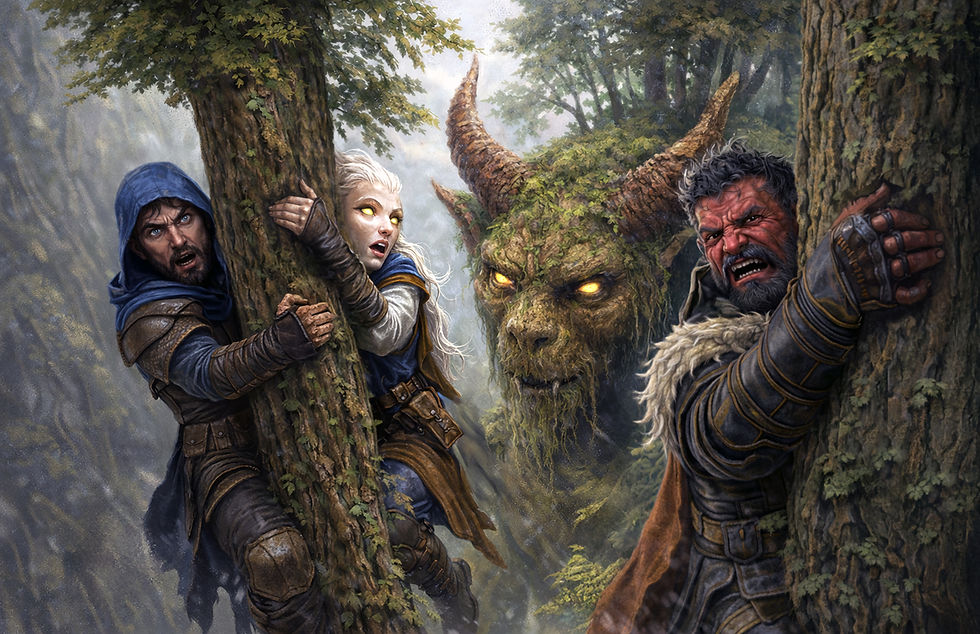
I'm primarily going to talk about tabletop role-playing games, but I might venture into some video game concepts and other tidbits of storytelling to make a point or two.
Set the scene
Art is everything, but sometimes you don't have images to share with your audience. Sound, descriptions, touch...use the other senses we're all equipped with to tell your story.
I found my artist online when I was first trying to gather art for Kromore, but to be honest Kromore really wasn't anything finalized until I had the vision to go along with the words I was writing. When you find an artist, or if you are magical and can write and draw, you really learn to tap into something special about designing a story with a full macro perspective.
Plot and over-plotting
There's a lot to plot about in any story. A good tabletop adventure nails down three things. Beginning, Inciting incident, Ending. I'll hit on all three and explain why the word Middle isn't part of the required structure. Does the middle matter to have plotted? Honestly If your beginning and ending are solid you don't need to plan the middle. You do need a launching off point, that's the inciting incident. A moment where all things become different. A gun has just gone off, a person dies, a change in the weather foreboding a future of dread. Yes these are all really downer type things, but challenges are often negative. You have to overcome them to feel like you've accomplished something. Or in some cases you have to fall even further into the tumultuous rabbit hole and find the other end. It's the inciting incident that propels your characters into the story. It should be early on.
Be flashy and bold. Don't be afraid to make a big entrance.
Make it yours
Why you shouldn't always steal from others, but maybe should.
RPG's aren't very original. Even when you find one that is it's just a quasi version of something else re-skinned with a different ip (intellectual property). This makes it easy to just rehash the same plot over and over with different settings. This is ok to a point, but eventually you'll run your audience bored. You really need to find new material or invent it to make your players interested. I find younger roleplayers tend to steal a lot more than older ones. This is usually because the older ones are bored of repeating content and they simply have played more games and adventured in the same IP's enough to know what they are getting into. New IP's and unknown stories are exciting and why you see so many random spinoff TTRPG games every year that someone somewhere is actually buying.
Cue, Reaction, Action
Just like in cinematic storytelling, playwriting, and acting, you want your RPG storytelling to represent the same values. Cue, Reaction, Action is something I picked up from stagecombat back in my college days swordfighting and hand stage fighting. You throw up a fist, your cue to the other fighters that something is about to happen, the reaction is the recognition that your other fighters know its coming, and then the actual action of throwing the punch and selling it as real.
Do the same thing in your storytelling. Set up an inciting incident or cue for your players to pick up on. Make sure they are giving some form of reaction to it, even if they don't know what is about to happen. SOMETHING has happened and they need to be aware, otherwise you are roleplaying in your own mind and they are lost in theirs. Once the reaction is set to the cue, send in the clowns, or whatever it is you intend to toss at your players for that moment. This simple technique is more about selling the moment and making sure they are invested in the moment to care.
Player Agency
This is a big one and honestly I could write a book on it. I won't, but it's a thing to pay attention to. What it means is simply let your players make decisions that actually have impacts and stay out of the way of the decision making process. As the Storyteller guide them along their jouney, but let it be theirs. I can't tell you how many RPG groups I've left because the GM railroaded the story into their own personal movie. As a player I'm not there to sit and watch your game. I'm there to participate in a new game that we are improvising on the spot. The storyteller creates and sets the scene, the players make it their own. This is probably the most important thing in any TTRPG game, and in most video games, and board games. If the story is dictated you are reading a book or watching a movie. If it allows the player to make choices that actually matter, you are playing a game. I don't join game groups to sit and watch a pre-dictated story and neither do your players. Okay I'm off topic a bit, but let's move on.
Don't plan much.
Improvise
One of my favorite ways to run a game is to improvise 99% of it. I know the universe pretty well typically and well, i wrote it. It's easy to just throw stuff from the decades of content and let my players explore it. The hard part is being able to improvise new things. I know, it's tough and you haven't memorized the books and ttrpg lore like I have. Honestly, I forgot most of the details and don't really check half the time. One of the reasons I have such a large lore to pull from in my content is that I just improvise new things within the settings. It just makes for the next game to be that much more exciting that I use 1% of written lore and improvise the other 99. Now the next game I run has new content already locked in. When I'm at a convention I often use the first games as impact story in the background of the setting and let the players dictate the future game stories as I go. I don't have to rely on my notes and take time away from the table, I'm all in and just running with their story as they see it and make it in real time. Improvising takes practice, it takes patientce, but above all it takes listening. Listen to what your players are saying and what they seem interested in. Let them do those things. Don't stop them from casting spells, exploring places you didn't prepare, or getting into conflicts that seem off track. Weave your main story back into those off shoot adventures or make up a new one that is better on the fly. That's what makes a good adventure and gives the players a feeling that they truly did something unique and it was all theirs. I'll probably add to this blog post, but it's currently now been a work in progress for over a decade. As I launch the Avery Bishop Chronicles and Kromore 2nd Edition i'll come back and poke at this blog and maybe edit it. It's pretty rough, but that's what a blog should be. Not prepared or planned out, just a stream of thought. And on that, I'm out. -T. Julian



Comments